|
||||
39. Taenite ribbons - Arlington, Sokoto |
| Return to Contents |
| Back...Next |
| Meteorites - Arlington, IIE ungrouped iron, Sokoto, IIIAB Iron. |
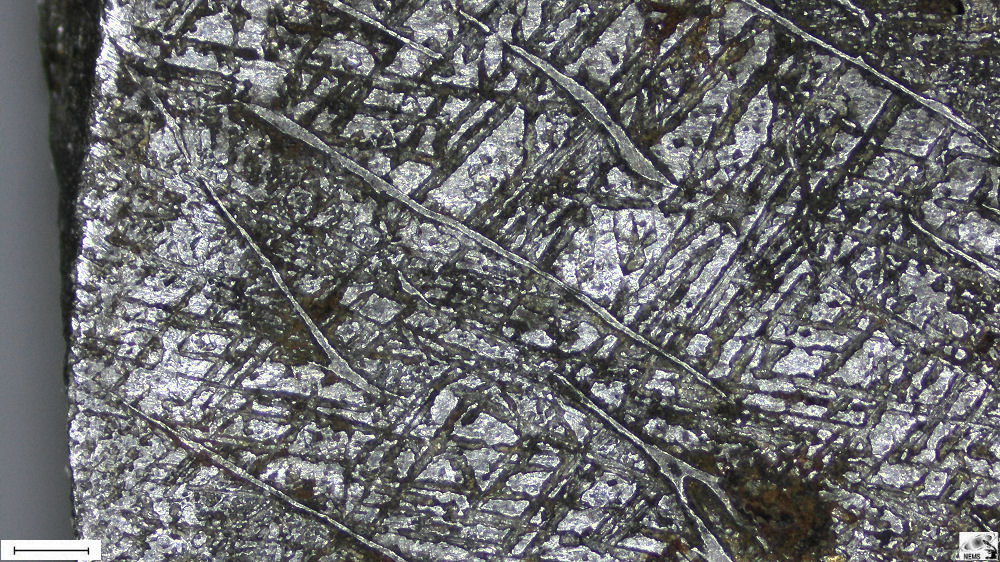
| Figure 1. |
| Taenite ribbons (residual
high-Ni γ-phase) bordered by kamacite in a polished and etched section.
Scale bar typical of microstructural work: 100–300 µm. Arlington IIE
iron meteorite |
| Taenite ribbons in Iron
Meteorites and Pallasites Taenite ribbons are the narrow, continuous or discontinuous bands of residual taenite (γ-FeNi) that remain between kamacite plates after the development of the Widmanstätten pattern. They are a primary metallographic feature of slowly cooled iron meteorites and the metal matrix of many pallasites. Complex Phase Transitions During Slow Cooling The formation and internal structure of taenite ribbons record a sequence of solid-state phase transformations that occur as the metal cools from high temperatures over millions of years: 1. Single-phase taenite field: At temperatures above approximately 800–900 °C (depending on bulk Ni content), the metal exists as homogeneous face-centered cubic taenite (γ-FeNi). 2. Entry into the two-phase field and kamacite nucleation: Upon cooling into the α + γ field (typically beginning near 700–750 °C), body-centered cubic kamacite (α-FeNi) nucleates and grows as oriented plates, forming the classic Widmanstätten pattern. Ni is rejected from the growing kamacite into the adjacent residual taenite, progressively enriching the taenite ribbons in nickel. 3. Ni enrichment and diffusion-controlled growth: Continued slow cooling allows solid-state diffusion of Ni. The residual taenite becomes increasingly Ni-rich (often reaching 25–50 wt% Ni or higher near the interfaces), producing the characteristic M-shaped Ni concentration profiles measured across taenite ribbons. 4. Plessite formation in residual taenite: At still lower temperatures (roughly 500–400 °C and below), the Ni-enriched residual taenite becomes unstable and transforms into various plessite morphologies (acicular, cellular, net, or comb). Acicular plessite, consisting of fine needle-like kamacite within a taenite matrix, commonly develops within or adjacent to the ribbons. 5. Cloudy-zone formation: In the outer portions of taenite ribbons, further cooling (commonly below ~400–300 °C) produces the cloudy zone—a nanoscale intergrowth resulting from spinodal decomposition or fine-scale nucleation of kamacite particles within the high-Ni taenite. 6. Ordering to tetrataenite: At the lowest temperatures (approximately=320 °C), the Ni-rich rims of taenite ribbons can order into tetrataenite. This ordered phase is magnetically distinct and forms thin, continuous rims that are optically and crystallographically recognizable. These transitions are diffusion-controlled and highly sensitive to cooling rate. The final width, Ni profile, cloudy-zone particle size, and presence or absence of tetrataenite rims therefore serve as quantitative recorders of the thermal history of the parent body or fragment. Petrogenetic Significance In pallasites such as Glorieta Mountain, taenite ribbons and their internal phase transformations preserve the low-temperature cooling path of the metallic matrix after olivine and metal had already been juxtaposed. The sequence of kamacite growth, residual taenite enrichment, plessite development, cloudy-zone formation, and tetrataenite ordering provides a continuous record spanning several hundred degrees of cooling and millions of years of asteroidal thermal evolution. |
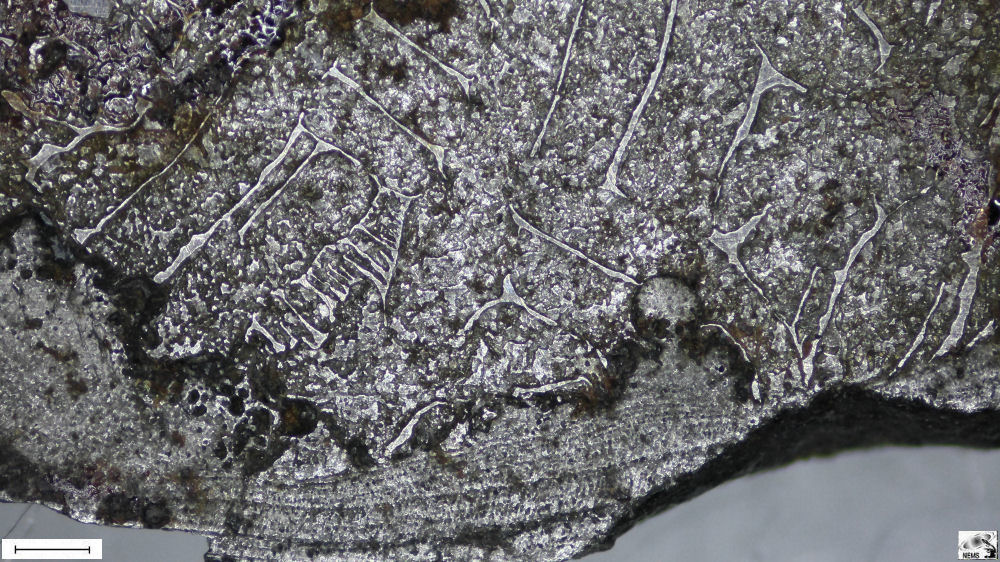
| Figure 2. Taenite ribbons bordered by kamacite. Scale bar 900 µm. Arlington, IIF iron meteorite. |
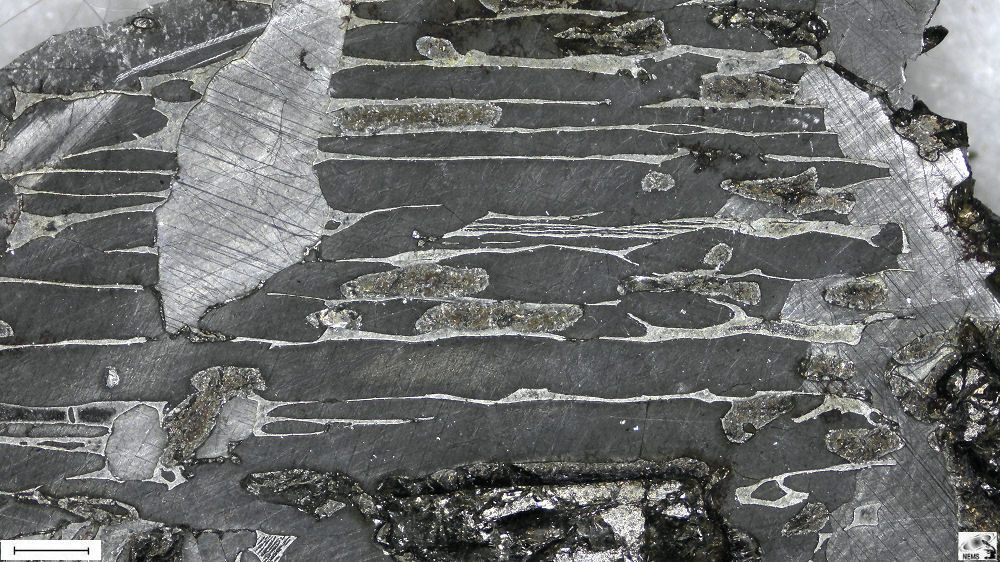
| Figure 1. Scale bar 900 µm. Sokoto iron meteorite, IIIAB |
| References • Buchwald, V. F. (1975). Handbook of Iron Meteorites. University of California Press. • Goldstein, J. I., & Michael, J. R. (2006). The formation of plessite in meteoritic metal. Meteoritics & Planetary Science, 41, 553–570. • Yang, J., Goldstein, J. I., & Scott, E. R. D. (2010). Main-group pallasites: Thermal history, relationship to IIIAB irons, and origin. Geochimica et Cosmochimica Acta, 74, 4471–4492. • Reuter, K. B., Williams, D. B., & Goldstein, J. I. (1988). Low temperature phase transformations in the metallic phases of iron and stony-iron meteorites. Geochimica et Cosmochimica Acta, 52, 617–626. • Goldstein, J. I., Yang, J., & Scott, E. R. D. (2014). Determining cooling rates of iron and stony-iron meteorites from measurements of Ni and Co at kamacite–taenite interfaces. Geochimica et Cosmochimica Acta, 140, 297–320. |
| Listing of Structures |